
Ecosystem Build
News & Events
Stories, research and events from the Ecosystem Build and i4Policy community. Each card opens the full article on ecosystem.build.

Championing Africa’s Startup Revolution
The Pan-African Policy Task Force recently held a global webinar entitled Connecting the Continent: Data, Policy and People. Policymakers, innovators and entrepreneurial stakeholders gave feedback on progress made in the entrepreneurial ecosystem on the continent. The Pan-African Policy Task Force held a successful webinar early in July 2026, where participants heard that the initiative has been expanding rapidly since its launch in 2022. Aniya Hamilton of the Innovation for Policy Foundation (a partner to the taskforce) reflected back on its beginnings, “I am happy to tell you that back in 2022 we had 45 members from all corners of the globe and four years later, we are now at a solid 150 members in the Pan-African Policy Task Force” Webinar attendees hailed from the Netherlands, the US, Ghana, Rwanda, Kenya, Nigeria, Cameroon, Botswana and South Africa, among others. The Task Force is a collaboration between Smart Africa, the Innovation for Policy Foundation, Stellenbosch University and the Allan Gray Centre for Africa Entrepreneurship (AGCAE). In her opening remarks, Hamilton highlighted that one of the main aims of the Task Force is to build smarter policy actors and a more intelligent ecosystem that serves everyone – which is vital at a time when funding is even harder to come by due to changing geopolitics and economic strain. Then Michelle Harding from the Council for Scientific and Industrial Research (CSIR) spoke about the newly created South African Innovation Policy Hub which will soon be publicly launched. ‘We need intelligent data and good data systems’ Harding spoke about the lack of policy coherence in South Africa. “We have different government departments, each with their own policies, each with their own instruments of implementing these policies.” She mentioned bottlenecks holding back development and initiatives and for her, the solution was improved data and intelligence gathering, which the South African Innovation Policy Hub would focus on. Promoting ecosystem intelligence means defining what kind of data should be gathered and establishing the most effective ways of analysing and disseminating it. By continuously evaluating these efforts, it is hoped that in-depth research into the relationship between entrepreneurship and innovation systems can be developed. Harding said outcomes would be shared on a digital platform, the Innovation Bridge Portal. This online platform has been available for some time with a wealth of opportunities, events and up to 770 innovations for public viewing. Other interesting speakers included Lukonga Nintunda, co-founder of BongoHive, an innovation and technology hub in Zambia, which supports nearly 2 000 startups. “When we started BongoHive 15 years ago, I didn’t think policy was important. I wanted to stay away from politics,” he admits. But over time, he learnt how vital it was to build relationships with regulators, government partners and all those involved in the entrepreneurial space. ‘I wanted to stay away from anyone who talked too much and did nothing’ Nintunda learnt that it was not about becoming an expert at policy but becoming more of a convenor, specifically bringing impactful people together. He shared an anecdote about talking to a minister in Zambia who said he wanted to visit the BongoHive physical office. “He didn’t want to see us online. A lot of people are old-fashioned like that.” But at the end of the day, it is relationship-building. And BongoHive has organised webinars and held events, getting to know stakeholders personally. They have become consultants and policy advisors and have contributed to the country’s new data protection and Zambia’s national AI strategy. The importance of data, digital skills and online entrepreneurial activity came up again and again at the webinar. In the next session, Dr Phumlani Nkontwana, AGCAE director, invited participants to have a look at the newly-updated Africa Entrepreneurial Ecosystem Index. ‘You don’t have to be a data person to use the Index’ The Index offers a wealth of data, comparisons between countries in Africa according to various criteria and rankings. “Africa generally struggles to break beyond the middle-income bracket, but we can use ecosystem intelligence to try and close that gap,” he said. Dr Nkontwana said the new data offered valuable information on the state of the entrepreneurial process in African countries. “The important thing is to democratise ecosystem intelligence so that you empower people to understand their own contexts and think carefully about how to make decisions.” By comparing how countries fare on key indicators, powerful data is offered, free for download. In closing, Hamilton reiterated what many of us have come to understand, that strengthening the entrepreneurial ecosystem was a slow process. “It is a marathon, not a sprint. Sometimes you do feel the pressure to go for the sprint, because the funding climate is geared towards quick wins. But persistence is key.”

A sharper lens on African entrepreneurship: launching the AEEI 2026
The Africa Entrepreneurial Ecosystem Index moves from working prototype to a peer-reviewed standard, paired with a new diagnostic dashboard. On Friday 26 June 2026, the Allan Gray Centre for Africa Entrepreneurship (AGCAE), Utrecht University, and the Innovation for Policy Foundation (i4Policy) officially launched the updated Africa Entrepreneurial Ecosystem Index (AEEI). The announcement took place before a room of young changemakers, aspiring entrepreneurs, government officials, financiers and enterprise support organisations at the Absa Youth Month Event in Johannesburg, South Africa. Presented by Absa Group Limited Corporate Citizenship in partnership with AGCAE, this creative convening gathered youth entrepreneurs and vital ecosystem stakeholders to promote financial inclusion through entrepreneurship. The very people the index is built to serve were the first to watch Dr Phumlani Nkontwana and Lincoln Njogu walk through the new AEEI 2026 dashboard. The energy in the room confirmed that the work had landed. Here is what has changed. From prototype to peer-reviewed standard When the first AEEI appeared in 2024, we asked readers to treat the results with caution and called it a minimum viable product. The 2026 release sits on firmer ground. Its methodology is now published in World Development, one of the leading peer-reviewed journals in the field. The paper constructs the index from 21 indicators across seven dimensions: governance, culture, finance, support, infrastructure, market access and human capital. The study also shows that the AEEI predicts real-world entrepreneurial outcomes across African countries more accurately than GDP per capita does. What began as a conversation starter is now an evidence base that policymakers, investors and researchers can build on. And all are still invited to further refine and develop this important contribution to science, practice and policy. Forget about the rankings Mauritius is still number one. Good, now that I have your attention, you can forget about it. The real value of the index lies underneath the headline. The new dashboard is built to be interrogated. Users can set countries side by side, unpack any of the seven challenge areas, and drill down into the sub-indicators beneath them, travelling from a single overall score directly to the raw data points. A ranking tells you where a country stands. A diagnostic tells you what to fix first. By making every dimension and indicator inspectable, the AEEI becomes a policy instrument for targeting reform rather than a league table to argue over. It brings African ecosystem-builders closer to a shared, evidence-led starting point for resource allocation. Notable movements in 2026 As data coverage expands, Mozambique enters the index in 25th place out of 30 countries. At the top of the table, the strongest performers hold their positions, a sign that the index is tracking something durable. A few countries shift position, and the detail is where the value lies. Compared to the 2024 beta edition, The Gambia rises four places, while Nigeria moves down five. They follow, almost entirely, from sharper methodology and upgraded data sources. The Gambia’s upward trajectory was driven primarily by gains in human capital, specifically regarding R&D investments and life expectancy. Conversely, Nigeria’s ecosystem quality declined, largely as a result of diminished market access, particularly reflected in GDP and household income indicators. Open by design The full data file is available to download. Version 2.0 also includes a technical user manual documenting data sources, collection processes, indicator definitions and the methodological framework behind the index, ensuring the numbers can be understood, applied and reproduced with the full data file for version 2.0Explore the dashboard, download the data, and tell us what you find at africa.ecosystem.build. Reference: Stam, E., Nkontwana, P., McDonald, R., Murenzi, R., Addo, K. A., Bayuo, B., Baah, B., Riezebos, S., & Gelissen, T. (2026). Measuring national entrepreneurial ecosystems in Africa. World Development, 202, 107357. https://doi.org/10.1016/j.worlddev.2026.107357

Why governments keep making the same policy mistakes and how AI could help fix that
Every few years, a government somewhere decides its startup ecosystem needs fixing. It commissions research, identifies the gap, and funds a wave of accelerators and pitch competitions. Activity goes up. Founding rates tick upward. Politicians cut ribbons. Then the cohort graduates, and most of the companies quietly die, because the binding constraint was not only never early-stage capital. It was the absence of customers, or procurement rules that locked out young firms, or a talent market that kept draining to larger cities. The signal was real. The diagnosis was wrong. This is the policy trap that more data alone cannot escape. Governments are using AI more than ever, but mostly to do paperwork faster: summarising consultations, grouping evidence, flagging patterns. Useful, yes. Transformative, not yet. A recent white paper by Systemic Innovation, sistemaFutura and i4Policy puts a name to the problem: the interpretation gap. What we mean by this is the distance between knowing what the data shows and understanding what will actually happen when a policy hits the real world. More information (or signals) doesn’t close that gap. It can even make it worse, burying teams in signals nobody has time to reason through. Marrying AI with ADDIS Decision Thinking Closing the interpretation gap is a process design problem. That’s where AI can meet methodologies like i4Policy’s ADDIS Decision Thinking; a structured, human-centered framework for moving through the full policy cycle. Embedding AI inside that kind of workflow shifts the question from “what does the data show?” to “what will this decision actually do?” In practice, that means five things: The bottom line There’s a version of AI-for-policy that just makes bureaucracies faster at being wrong. And there’s a version that helps decision-makers reason more carefully about complex systems, test assumptions before committing resources, and learn from what actually happens. The difference isn’t the algorithm. It’s the process wrapped around it. Read the paper here: https://www.yumpu.com/en/document/view/71107687/ai-for-policymaking-beyond-signal-detection Written by Tim Gelissen
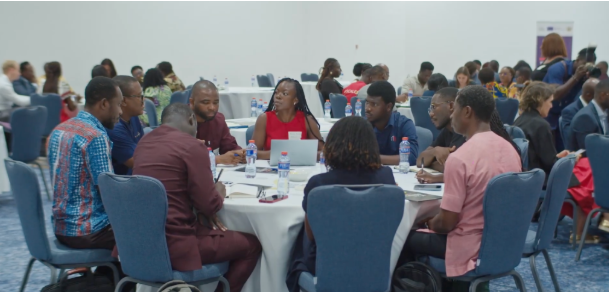
Ghana’s Green & Digital Transition Through a Participatory Lens
From December 2025 to April 2026, i4Policy supported the inception phase of the Ghana Green & Digital Inclusive Private Sector Development programme alongside Expertise France and partners working under the EU Global Gateway framework. The work focused specifically on the policy and ecosystem dimensions shaping green and digital SME development in Ghana’s Creative and Cultural Industries (CCI) and Health & Pharmaceutical sectors. As implementers of the inception study, our role was to map the policy landscape, engage ecosystem actors, identify barriers and opportunities, and help surface practical pathways for future programming and intervention design. The process combined ecosystem diagnostics with participatory engagements designed to ground policy conversations in lived realities rather than assumptions. Participatory policymaking at the forefront Remaining true to our mission, participation was at the heart of the engagement process. Across the study, we worked with entrepreneurs, regulators, ecosystem support organisations, creatives, health innovators, development partners, and public institutions to better understand how Ghana’s green and digital transitions are unfolding in practice. The engagement process included: The discussions were incredibly layered. In one conversation, stakeholders discussed telemedicine regulation and data governance. In another, creatives explained how difficult it can be to certify upcycled products or monetise digital content in systems that were not originally designed for newer creator-economy models. What became clear very quickly was that green and digital transitions are already happening in Ghana, but often faster than policy and institutional systems are adapting around them. What we discovered One of the strongest findings from the study was that Ghana’s “green” and “digital” transitions are still largely happening in parallel rather than as one coordinated “twin transition.” Digital adoption is advancing relatively quickly across both sectors, while sustainability efforts remain more fragmented and harder to operationalise. Across engagements, stakeholders repeatedly highlighted: The research also surfaced strong entrepreneurial experimentation despite these constraints. Entrepreneurs in the Health sector discussed their journey to building telemedicine platforms and digital traceability systems. Creative entrepreneurs shared experiences using digital platforms, circular production methods, and sustainable materials to rethink production and distribution models. Working through ambiguity in real time Internally, the process required a constant balancing act between depth, timelines, logistics, and synthesis. One of the biggest strengths of the project was having teammates physically on the ground in Ghana while the research was ongoing. That local presence made it possible to adapt quickly when schedules shifted, stakeholders became unavailable, or logistical challenges emerged unexpectedly. At the same time, the pace of the engagement meant continuously making difficult decisions about scope and prioritisation. Ironically, one of the hardest parts was not gathering information, but filtering it. There were so many rich conversations, perspectives, and ecosystem dynamics unfolding simultaneously that the real challenge became deciding what was most relevant and actionable within the timeframe of the inception study. The process also highlighted some important tensions around inclusivity. While the engagement achieved close to gender parity between women and men participants, logistical and timeline constraints limited participation from outside Accra, with only one stakeholder directly engaged from another region. That experience reinforced something we often see in ecosystem work: participation is not just about inviting people into the room. It is also about the infrastructure, timelines, funding, and coordination required to make broader participation realistically possible. The dissemination workshop, hosted by Expertise France in April 2026 reflected a deliberate effort to make the process more participatory and grounded in diverse ecosystem perspectives. Recognising some of the participation limitations encountered earlier in the study, the team mobilised additional logistical and financial support to bring together as many ecosystem actors as possible for an in-person engagement. The workshop gathered around 70 participants, including public institutions, entrepreneurs, creatives, health innovators, ecosystem support organisations, development partners, researchers, and regulators. Throughout the day, service providers presented findings from their respective studies before participants moved into smaller breakout discussions focused on themes such as entrepreneurship support and regulatory bottlenecks. A reminder about the intricacies of work on the ground This engagement reminded us that ecosystem and policy work rarely moves in a straight line. Stakeholders shift. Priorities evolve. Timelines tighten. Conversations open entirely new directions halfway through the process. And sometimes, despite careful planning, not every stakeholder you initially hoped to engage becomes part of the process immediately. That is okay. One of the biggest lessons from this work was learning to remain flexible while still moving the process forward. Consistent outreach, adaptive facilitation, and a willingness to work through ambiguity became just as important as the technical research itself. Because in many ways, inception work is exactly that, a starting point. A process of building relationships, identifying patterns, and creating enough shared understanding for deeper collaboration to continue afterward. Written by Aniya Hamilton

Navigating change and building the future through better innovation and startup policy
Written by Ilja Riekki Navigating Change and Building the Future through better innovation and startup policy : skilling, supporting instutionalization, governance and coordination mechanisms and service delivery. Africa is undergoing a remarkable transformation. As populations surge and urban centres expand, the continent is witnessing rapid economic and societal shifts. Many Sub-Saharan African countries record GDP growth rates from 8-6% of annually, rapidly advancing digitalization transforms domains and opens promising opportunities. A burgeoning middle class is fuelling the growth of national, regional, and even sub-national markets, while demand for goods and services rises in tandem. Yet, these opportunities are accompanied by significant challenges of job creation, high levels of informal labour market challenging domestic resource mobilization, high levels of youth unemployment, equitable access to education, skilling and lifelong learning opportunities. Many African nations still rely on official development assistance (ODA) and concessional loans, which are crucial for developing hard infrastructure — like transport networks, research institutions, and technology parks — and for building strong educational foundations. However, legacies of colonial boundaries continue to complicate regional cooperation, and questions linger about whose needs are truly being served—those of the donor countries or the African nations themselves. Despite these obstacles, certain African countries, such as Seychelles and Mauritius, now boast GDP levels comparable to parts of Eastern Europe, showing the continent’s potential for economic growth and global engagement. Institutional development is also in motion, continental African strategies for innovation, technology, and artificial intelligence are emerging alongside agreements for free trade and greater mobility of individuals, companies, products and investments. The Africa Union’s STISA 2034 strategy aims to transform Africa through innovation-driven growth, focusing on increased R&D investment, gender equality, and private sector engagement. Regional Economic Communities and continental multilateral and technical international organizations are a key for alignment and strengthening of national and sub-national frameworks, organizations and operations. Creating an Enabling Environment for Innovation Policy In this context of change and complexity, fostering innovation policy is more than a developmental necessity—it’s a strategic imperative. African countries face the dual challenge of sustaining social and environmental growth while empowering local populations to drive their own progress. Supporting innovation policies helps to strengthen local expertise, retain investment within the continent, and leverage the skills of Africans both at home and abroad. Nationally, mandates and responsibilities should be clarified to efficiently coordinate, collect intelligence and work with stakeholders across the wide variety of organizations withing innovation ecosystem. This will build a foundation for evidence and data led policy and decision making, every day management and development and delivery of services for thriving entrepreneurial and innovative societies, also increasing resilience. For European and Finnish partners and stakeholders’ collaboration offers mutual benefit. Not only does it create opportunities for business and the co-development of solutions to global problems, but it also encourages learning from diverse approaches and exchanging best practices in a wide variety of development objectives which fall under the concept of ‘innovation ecosystem’: from lifelong learning, skilling and academic development, STI policy, tech transfer and research commercialization, SME, startup and entrepreneurship regulation, policies and services, financial landscape and institutional development. This is achieved through supporting establishment of participatory practices and inclusive methodologies in governance systems. By investing in Africa’s capacity for innovation, all parties contribute to a sustainable, more resilient, and interconnected world. While over regulation might be argued as a threat, simultaneously, companies build in Europe are world class in terms of privacy and social sustainability. This is reflected as strengths in data governance and management, ethics by design, sustainability as a core factor in technological innovation and but also in terms of social innovation through withholding strong rights of consumers and workers – in current global turmoil, value in itself. AEDIB 2.0: Bridging Africa and Europe for Digital and Green Innovation The Africa-Europe Digital Innovation Bridge (AEDIB 2.0) stands at the crossroads of these developments. This ambitious project, where HAUS, Finnish Institute of Public Management participates as one of the European implementing partners, is part of the Global Gateway efforts and aims to foster innovation by supporting policy development implementation of regulatory frameworks and linked activities, technical and capacity development support for entrepreneurship support organizations (ESOs), stakeholders and financiers. Its priorities include nurturing start-ups, promoting industry growth linked to digitalisation, AI and green transition and solutions for sustainable development, and supporting market entry and growth through funding establishment of joint consortia directly to companies and public private partnerships. AEDIB 2.0 also recognizes the importance of tailored approaches: support measures are adapted to the specific needs of each participating country. This includes systematic consultation with stakeholders, multi-ministerial cooperation, and technical assistance for innovation structures. The project is a collaborative effort between the European Union and African partner countries, with funding provided by both the EU and participating EU nations through self-financing. Ultimately, AEDIB 2.0 represents a shared commitment to building future-ready entrepreneurship and innovation ecosystems—where African ingenuity and European partnership come together to address challenges, unlock growth, and lay the groundwork for sustainable prosperity on both continents. By 2028 AEDIB will have financially supported over 170 cross-border partnerships and over 70 digital small and growing businesses to scale their innovations, 14 Sub-Saharan African countries would have been supported through capacity development of policymakers, entrepreneurship support organizations and financiers, supporting the economic diversification, growth, job creation and entrepreneurial opportunities. This is first blogpost related to our work on innovation policy and AEDIB, we welcome you to follow our work through our channels to receive updates of the work in practice! Start exploring the ecosystem now, through Smart Africa Network on Incubators and Accelerators (SANIA): https://sania.smartafrica.org/. Written ByIlja RiekkiInnovation Policy ExpertAfrica-Europe Digital Innovation Bridge 2.0 (AEDIB 2.0) ProjectFinnish Institute of Public Management/ HAUS kehittämiskeskus This article was first published here by Haus:https://haus.fi/en/topical/navigating-change-and-building-the-future-through-better-innovation-and-startup-policyka1-skilling-supporting-instutionalization-governance-and-coordination-mechanisms-and-service-delivery/

When multilaterals compete
By Systemic Innovation How vertically integrated UN innovation programmes can distort markets – and what governance discipline would prevent it Over the past decade, multilateral organisations have become central actors in the innovation ecosystems of low- and middle-income countries (LMICs). They have financed early experimentation, convened fragmented stakeholders, and absorbed risks that private markets often avoid. In many contexts, that role is not only legitimate; it is necessary. The institutional form of innovation support has changed. A growing share of multilateral innovation activity, particularly within parts of the United Nations system, has shifted from facilitation and catalytic grantmaking toward vertically integrated innovation programmes. These programmes simultaneously finance innovation, operate delivery infrastructure (hubs, accelerators, labs, platforms), convene and broker partnerships, and define standards, metrics, and “what counts” as innovation. This configuration can produce visible outputs and impressive narratives. It can also generate a structural risk that is rarely measured and even more rarely governed: market substitution. In other words, multilaterals can move from correcting market failures to occupying contestable market space – while retaining legal, reputational, and financial privileges domestic actors cannot replicate. The concern is structural rather than motivational. Many of these programmes are led by competent teams with genuine public-purpose intent. The issue is architectural: the concentration of multiple roles across the innovation value chain without meaningful exit discipline. The argument in one line: mechanism, not motive The analysis focuses on institutional mechanisms rather than organisational intent. The appropriate unit of analysis is the innovation intermediary market rather than individual startups or programmes. Innovation ecosystems do not function through founders alone. They rely on intermediary functions – selection, acceleration, brokerage, venture building, ecosystem coordination, legitimacy signalling, and sometimes standard-setting. These functions reduce information asymmetries, structure pathways to capital and procurement, and determine whose solutions get seen, validated, and scaled. When these intermediary functions are concentrated within a single subsidised institution with bundled advantage and weak exit constraints, ecosystems become programme-rich but capability-thin. Lots of activity, weak independent market formation. In competition-policy terms, the relevant question is whether programme design preserves competitive neutrality, contestability, and exit discipline, or hardens into enduring market infrastructure outside market governance. Why this is structurally plausible: role collapse and bundled advantage Competition policy has a well-developed vocabulary for this: vertical foreclosure, bundled advantage, and standards capture. These risks arise independently of organisational behaviour, driven by configurations in which a single actor controls both upstream inputs and downstream delivery in a contestable domain. In the innovation context, “upstream inputs” include donor capital, privileged access to government counterparts, and legitimacy effects that shape pipeline formation. “Downstream delivery” includes operating accelerators, hubs, labs, and platforms. The typical role-collapsed configuration includes: Figure 1: Role collapse as a market-structure mechanism These roles form a single, vertically integrated selection and delivery stack with predictable market effects. When upstream advantage, intermediation, and delivery are combined within a single institution, selection power replaces. competition and predictable market effects follow. Distortion arises from configuration and persistence, not intent. In many LMIC contexts, the combined effect is non-contestability. Domestic intermediaries may exist, but they cannot compete on equivalent terms when an institution has: global brand legitimacy, donor access, privileged proximity to ministries and procurement channels, and limited exposure to “failure disciplines” (bankruptcy, market exit, mandate loss). Innovation ecosystems mature through learning-by-doing and competitive variety; a single dominant gateway suppresses entry and narrows pathways to scale. The hidden system-level consequences: five predictable effects Vertically integrated multilateral innovation programmes generate predictable system-level consequences, even where programme-level outputs appear strong. Five system-level effects recur: These effects are poorly captured by standard monitoring and evaluation systems. That is precisely the point: existing accountability architectures are optimised for fiduciary compliance and output reporting, not for market health. Why evaluation rarely catches this Most multilateral oversight systems were not built to assess market-structuring externalities. Financial audits focus on compliance. Evaluations often focus on effectiveness against programme objectives. Even sophisticated innovation evaluations tend to assess internal coherence and scaling logic rather than ecosystem-level effects such as crowd-out, intermediary displacement, or standards capture. This creates a governance blind spot in which programmes can be labelled “successful” while weakening the conditions for independent ecosystem formation. Treated as a market-shaping intervention, this gap becomes significant. In other policy domains – subsidy control, state aid, state-owned enterprise oversight, competition regulation – governance often relies on structural risk tests precisely because harm is hard to prove ex post and can become entrenched before it is measurable. Innovation governance has not yet caught up. A practical tool: the Presumption-of-Distortion Test The report proposes a Presumption-of-Distortion Test: a structured way to identify high-risk configurations ex ante (without arguing about intent or waiting for definitive proof of harm). A multilateral innovation programme should be treated as presumptively distortive where a majority of the following conditions apply: This is not a binary (pass/fail) test. It is a risk classification tool that triggers proportionate governance responses: enhanced additionality testing, commissioning requirements, mandatory exit planning, and market-health reporting. What “better” looks like: stewardship, not ownership The alternative is stewardship-oriented innovation support: programmes designed to build markets and capability rather than institutional ownership of innovation infrastructure. Figure 2: Ownership versus stewardship as governance logic At root, the difference between substitution and market-building is not ambition or competence, but where decision rights sit and how authority is constrained. When decision rights are internalised, innovation programmes become market-substituting; stewardship constrains authority to enable exit and capability externalisation. Six governance principles follow: A minimal reform package that is institutionally feasible A frequent objection to governance reform is feasibility and those in power say, “this would require mandate change”, “this would disrupt delivery”, “the chiefs won’t accept it”. That is why the report proposes a minimal reform package – six governance constraints that can be applied via donor conditions, formal (country or UN office) approval requirements, and internal risk/evaluation policies, without dismantling existing programmes: The logic is straightforward: if programmes behave like market infrastructure, they should be governed with comparable discipline. The difficult constraint, is actually restraint

Policy, powered by people: A Q&A with Lincoln Njogu
When a career hits a plateau, what do you do? For Nairobi native Lincoln Njogu, the answer was a strategic pivot fuelled by passion. Now the Head of Tech Development at the Innovation for Policy Foundation (i4Policy), Lincoln is tearing down the walls of closed-door policy-making, building digital bridges that allow African youth and entrepreneurs to co-create the laws that govern their innovation ecosystem. His journey is a testament to the power of integrating tech know-how with community-driven purpose. From Accelerator to ArchitectFor nearly a decade, Lincoln Kibethi Njogu was deeply embedded in Nairobi’s vibrant tech ecosystem, facilitating incubation programs and accelerators. Despite having an MBA and working on impactful projects, he reached a point where the work “just wasn’t challenging me any longer.” Coincidentally timed with the onset of the global pandemic and the arrival of his first child, this moment of reflection became “Phase 1 of a larger career game plan.” He transitioned from community development to product design, which unexpectedly opened the door to policy work at i4Policy. Now, his focus is on working with AI for policy and participatory policymaking—a full circle integration of his expertise in community, technology, and design. “A lot of people knew me as a community developer, not as a product designer,” Lincoln recalls, noting the initial challenge of winning over sceptics. He overcame the “twinge of ‘imposter syndrome’” simply by showing tangible results: the products he built were being used and subscribed to. Today, he’s also a PhD student and still a core team member for Droidcon, the annual Android developer conference in Kenya, proving that a pivot doesn’t mean leaving passion behind—it means integrating it. Building Policy with People: A Q&A with Lincoln NjoguWe sat down with Lincoln to discuss how he’s using technology to empower grassroots ecosystems and put Africa at the forefront of the global AI conversation. Q: i4Policy is known for participatory policy innovation in Africa. Can you unpack what that means?It means co-creating policies with the people they affect. Most policies are made behind closed doors. We are helping tear those doors off their hinges by building platforms that empower citizens—young entrepreneurs, educators, and ecosystem builders—to meaningfully shape the laws that govern them. For entrepreneurs, this leads to more relevant, inclusive policies that reflect their on-the-ground realities and remove barriers to innovation. Q: What role does technology play in bridging the gap between governments and grassroots ecosystems?Technology is the crucial facilitator. It allows for open, structured, and scalable engagement. We transform scattered feedback into actionable insights, enabling governments to collaborate directly with those who make up the grassroots entrepreneurship ecosystem. It makes the conversation efficient and equitable. Q: You’re now focusing on AI. How do you feel about Africa’s position on the global tech stage in this area?I’m incredibly proud. Africa is not lagging in terms of adoption and technology. In fact, based on what we can do, we are actually at the forefront when it comes to AI adoption and integration. I see developers building products that match those in the Global North, policymakers questioning AI, and academia investing in research. In Kenya, we have this synergy where CTOs, academics, and developers are meeting and collaborating. We are moving in this direction at this time, and I am proud of our continent’s position. Q: Could you share a project that highlights the direct benefits of inclusive policymaking for young entrepreneurs?A great example is the Citizen Engagement Platform (CEP), which we developed in collaboration with GIZ and the African Union Development Agency (AUDA-NEPAD). This platform facilitates structured dialogue between citizens and institutions like the African Union. Through this platform, we worked with the Women, Gender & Youth Directorate (WGYD) to mobilise youth, resulting in a Youth Organisation Database with over 1,500 youth-led groups This platform supports young people, especially young entrepreneurs, to influence the policies that impact their lives. It allows them to connect, collaborate, and showcase their impact, ensuring they remain actively involved in Africa’s development. The Power of the PivotLincoln’s journey from a career plateau to leading tech development in policy is an inspiring lesson in adaptation. He faced scepticism and self-doubt, but his belief that “tomorrow should never be the same as the previous day” pushed him to seek a greater challenge where his passions could truly integrate and amplify. He is not just building software; he is building democratic infrastructure, one digital platform at a time, ensuring that the voice of the young African innovator is heard where it matters most. “Africa is not lagging in terms of adoption and technology. We are actually at the forefront – and I’m proud of our continent, moving in this direction at this time.” – Lincoln Kibethi Njogu This article was originally published by the Anzisha Prize team: https://anzisha.org/policy-powered-by-people-a-qa-with-lincoln-njogu/. Special thanks to Lynn Brown for the great feature!

From innovation theatre to absorptive reform: Rethinking challenge programmes in African countries
By Systemic Innovation &i4policy Across Africa, challenge programmes have become a standard way to talk about reform. Ministries launch GovTech calls, climate innovation challenges, and startup prizes. Donors fund rounds designed to “scale what works.” Intermediaries run accelerators and bootcamps to prepare applicants. The surface story is one of momentum. But just beneath it sits a more uncomfortable pattern: very few of these pilots ever make it into policy, budgets, or routine public service delivery. The ideas are often sound. The problem is what happens when they collide with real systems. The report African Challenge Programmes: Rethinking Innovation Infrastructure for Absorptive Public Reform argues that the binding constraint is not creativity but absorptive capacity – the ability of public institutions to recognise, integrate, and sustain new solutions. Challenge programmes are being asked to deliver institutional change in systems that are not ready to absorb it. 1. The Absorption Gap Challenge programmes are attractive because they promise several things at once: political visibility, access to entrepreneurial talent, and a way to bypass slow internal processes. Over the past decade, donors and governments have come to treat them as a kind of universal instrument for public problem-solving. The evidence tells a different story. Evaluations across sectors show the same pattern: a long tail of pilots which demonstrate technical feasibility but go no further. The report calls this the absorption gap – the distance between a working pilot and a reform that is actually embedded. Behind that gap sit four systemic blockages that recur across African contexts: These blockages interact in a reinforcing cycle that generates pilots but prevents institutional uptake or reform. Under these conditions, challenge programmes drift into innovation theatre: activity that doesn’t stick, with pilots accumulating in the familiar pilot graveyard. This reframes the problem: shifting the debate away from ecosystems and innovators (the dominant OECD lens) toward the capacity of states to absorb innovation, and from model-heavy instruments to the incentives, authorising environments, and donor design failures that determine whether adoption ever occurs. 2. Why This Matters Now The cost of that theatre is rising. African governments face a decisive decade. Demographic pressure, climate risk, digitalisation, and shifting labour markets are rewriting the expectations citizens place on the state. Innovation has moved from a peripheral agenda item to a core ingredient of policy legitimacy. At the same time, markets are moving faster than public systems can adapt. In fintech, AI, logistics, healthtech, and climate solutions, firms are experimenting at a pace that outstrips regulatory capacity and procurement reform. The result is a widening gap between what is technically possible and what public systems can safely absorb. Challenge programmes sit directly in this gap. They are often deployed as a way to “catch up” – to bring entrepreneurial capability to bear on public problems. When they are not linked to state capability, however, they deepen the cycle of short-term experiments and long-term frustration. Each failed round makes it harder to persuade officials, founders, and citizens that the next one will be different. The report’s core argument is that this is not inevitable. Challenge programmes can become infrastructure for reform – but only if they are designed around the absorptive capacity of the systems they are meant to influence. 3. Readiness to Absorb: A Different Starting Point The report reframes the task entirely – away from “Which solutions should we pick?” and toward “What must the system be able to do for any solution to take root?” To answer that, it introduces a Readiness-to-Absorb Framework built around six interdependent domains: These domains form an integrated capability architecture. Strength in one does not offset weakness in another: a strong technical unit cannot compensate for a fragile mandate; robust political backing cannot substitute for a non-existent procurement route. In most African ministries, readiness is uneven across these domains. That is not a criticism; it is the institutional reality. The implication is straightforward: challenge programmes must be calibrated to these starting conditions rather than assuming high readiness by default. 4. From Readiness to Design Readiness is not an abstract diagnostic. It translates into a set of design choices that determine whether a challenge programme becomes a reform instrument or a one-off contest. The report identifies six design levers that map directly onto the readiness domains: Most existing challenge programmes work with some of these levers implicitly. Very few treat them as the primary object of design. The tendency is to focus almost exclusively on sourcing and supporting innovators, while assuming that institutional adoption will follow if the solutions are good enough. The report inverts that logic. It argues that the central task of challenge design in African public systems is to work these levers deliberately, in ways that incrementally raise readiness across cycles. The quality of the winning solutions matters, but it is not where most of the risk lies. 5. Sequencing: Challenges as a Capability-Building Journey Perhaps the most consequential element of the report is its treatment of time. Many challenge programmes are structured as single cycles: issue a call, select winners, run pilots, produce a final report. The expectation – explicit or not – is that good solutions will then be scaled. The report treats this as structurally unrealistic in low- and medium-readiness environments. Instead, it proposes understanding challenge programmes as multi-cycle capability-building journeys, each cycle tailored to the current level of readiness. It sketches three broad stages: Cycle 3 – Adopt & Scale (high readiness): Only once mandate, capacity, and pathways are in place does it make sense to design challenge rounds whose explicit aim is scale – through budget integration, outcome-based contracts, or regulatory reform. The key point is that these cycles cannot be collapsed without penalty. Attempting to jump directly to an “adopt and scale” challenge in a low-readiness system almost guarantees further contributions to the pilot graveyard. Running a Cycle-1-style convening and diagnostic process in a high-readiness environment, by contrast, will under-use the system’s potential. Sequencing therefore becomes a strategic choice, not a procedural detail. 6. Implications

Ethiopian data foundations: Building the evidence for an entrepreneurial economy in transition
By Dr George Windsor, Scott Walker (Systemic Innovation), and Professor Erik Stam (Utrecht University). Supported by the International Growth Centre (IGC) Ethiopia 1. Context and Purpose of the Study Ethiopia is entering one of its most active reform periods for entrepreneurship and innovation in its recent history. The new Startup Proclamation, the gradual opening of capital markets, and some actors within the government assert a broader ambition to act as an “entrepreneurial state” as policy design shifts towards reform implementation. The question for policymakers is whether the measures now in place can visibly improve firm performance and ecosystem capability. Yet the data available to answer that question remain limited. Global indexes such as the Africa Entrepreneurial Ecosystem Index (AEEI) place Ethiopia toward the lower end of African startup systems – accurately capturing structural constraints, but offering only a static snapshot. At the same time, national and donor-funded programmes generate large volumes of project data that are rarely compatible or comparable. Together, these sources describe the environment but not the dynamics of change: how reforms, finance, and institutional capacity translate into firm behaviour, growth, or survival. The Ethiopian Data Foundations study was developed to bridge that evidence gap. Supported by the International Growth Centre (IGC) and delivered by Systemic Innovation alongside global ecosystem authority, Professor Erik Stam, it integrates two complementary layers of data: By combining these, the study moves from description to diagnosis – offering a systemic view of how firm outcomes and ecosystem conditions interact. It introduces four Systemic Growth Metrics: scale-up conversion, capital leverage, dropout, and ecosystem recycling – that can be read alongside existing government information systems to assess whether reforms are leading to stronger, more resilient entrepreneurial growth. The intention is not to create another index, but to provide Ethiopia with a practical, locally governed framework to see whether its current reform window can produce the systemic effects it seeks. 2. From Benchmarking to Systemic Insight Cross-country indexes like the AEEI remain valuable for identifying comparative strengths and weaknesses, but they capture only macro level phenomena. Ethiopia’s position – 23rd of 29 countries in 2024 – reflects structural challenges that are well understood: limited finance, uneven market access, and weak entrepreneurship support. What such rankings cannot show is how these constraints affect micro level phenomena, like the nature and performance of firms. The Ethiopian Data Foundations framework adds that missing layer of analysis. It connects firm-level evidence on startup formation, employment, and funding with macro indicators across finance, governance, infrastructure, human capital, culture and more. This integration makes it possible to identify condition–outcome relationships – for example, how limited early-stage capital corresponds to high dropout, or how regulatory reform correlates with increased scale-up conversion. The approach is deliberately diagnostic, not implying direct causality. But it can help policymakers and ecosystem partners see where bottlenecks have the strongest systemic effect, and where targeted reforms could generate measurable improvement. In doing so, it shifts emphasis from external benchmarking to domestic learning – from knowing where Ethiopia stands, to understanding how and why it is changing. As a model, it is repeatable and replicable elsewhere. 3. Ethiopia in Transition The data show a nascent ecosystem that seems to be taking off. Nearly three-quarters of identified ventures have been founded since 2015, reflecting a surge of entrepreneurial activity supported by new digital infrastructure, investment reforms, and changing cultural attitudes toward enterprise. At the policy level, progress is tangible. The recently passed Startup Proclamation establishes the legal framework for startup designation, incentives, and support institutions. Parallel initiatives – capital-market liberalisation, investment-fund directives, and financial-sector reforms – signal a broader intent to embed entrepreneurship within Ethiopia’s economic strategy. Yet these reforms are outpacing the system’s absorptive capacity. Capital remains scarce, managerial talent thin, and ecosystem coordination fragmented across ministries and donor programmes. The consequence is a pattern common to nascent ecosystems: high entry, low progression. This is precisely where the Ethiopian Data Foundations framework adds value. By connecting firm-level outcomes to policy conditions, it enables national actors to track whether reforms are producing visible change – whether more firms are scaling, finance is compounding, or dropout rates are falling. The findings should be read not as a verdict on performance but as a baseline for learning: a picture of an entrepreneurial economy in motion, building the institutional and financial foundations on which future scale will depend. 4. From Activity to Capability: The Four Systemic Growth Metrics To move beyond description, the Ethiopian Data Foundations study introduces four Systemic Growth Metrics that track how startups progress within their ecosystem. These indicators reveal whether policies and support structures are converting entrepreneurial activity into sustainable scale. Each highlights a distinct dimension of ecosystem performance. Together, these metrics form a dynamic diagnostic: a way to assess whether the ecosystem is becoming more capable of turning entrepreneurial energy into cumulative growth. 5. What the Metrics Reveal Taken together, the metrics depict a system not yet efficient but clearly in motion – an ecosystem beginning to translate reform intent into measurable, if uneven, results. 6. From Data Fragmentation to Systems Integration The Addis Ababa validation workshop in October 2025 brought together government, academia, entrepreneurs, and development partners to test the study’s findings. Participants saw the framework not as another platform, but as a way to connect existing data systems across institutions. Ethiopia already holds a growing base of entrepreneurship data – from the Entrepreneurship Development Institute’s (EDI) databases and the Dealroom-powered Startup Ecosystem Platform to multiple donor monitoring systems – all of which could complement the Ministry of Innovation and Technology’s (MInT) forthcoming Startup Portal. Yet these sources still operate largely in isolation. Some information exists, but it does not circulate, connect, or accumulate to support coordinated decision-making or shared learning. The priority is therefore systems integration, not just infrastructure expansion. Ethiopian Data Foundations provides a shared evidence layer linking firm dynamics to institutional action by: Embedded within the Startup Proclamation’s governance structure, this model could turn disparate data into a coherent learning system-linking evidence generation to